
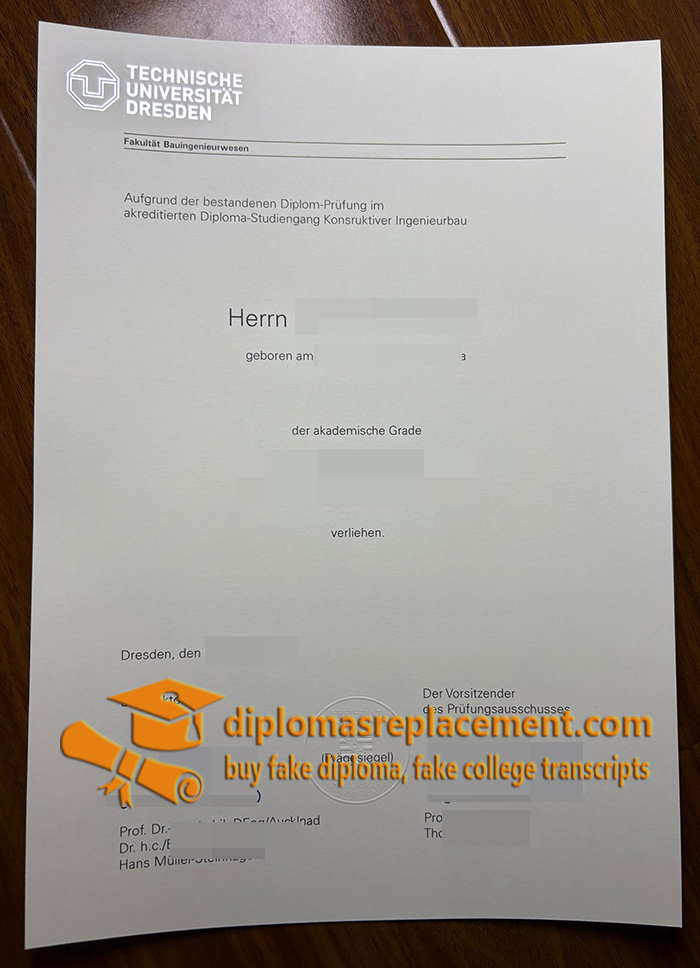
Dresden University of Technology (TU Dresden), founded in 1828, is located in Dresden, the capital of Saxony, Germany—often called the “Silicon Valley of Europe.” fake TUD Urkunde maker, It is one of Germany’s eleven “Elite-Uni” universities, a member of the TU9 Alliance of Excellence in Engineering, one of six German universities in the PEGASUS European Aerospace University Consortium, and one of seven German institutions in the TIME European Alliance of Top Industrial Management Universities. It is one of ten German universities in the CESAER European Conference of Universities for Advanced Engineering Education and Research, one of six higher education and research institutions in the Qualcomm European Innovation Prize Program, and one of Europe’s oldest and most prestigious technical universities since the Industrial Revolution.
Is it possible to get a fake TUD Urkunde in Germany?
With 126 academic programs, TU Dresden offers the broadest range of disciplines among German universities. Its 36,962 enrolled students (2013) rank it among Germany’s six largest universities. In 1994, it pioneered the Patent Initiative among German universities. In 2009, it spearheaded the “Concept Dresden Alliance,” uniting 14 leading cultural and research institutions alongside over ten museums and libraries. As Germany’s sole university collaborating with all four major research associations—the Leibniz Association, Max Planck Society, Helmholtz Association, and Fraunhofer Society—it ranked third among Germany’s 384 higher education institutions in 2012 with €227 million in third-party project funding.
The State and University Library Dresden (SLUB), founded in 1556 and officially opened to the public in 1788, relocated to its new building on Zellesche Street in 2002, consolidating all collections under one roof. With nearly 9 million volumes (8.94 million as of 2012), it ranks first among Germany’s 384 universities. It also stands as Germany’s and Europe’s largest science and technology library and one of the most significant centers for knowledge innovation and exchange.
The library houses a book museum, whose most renowned artifact is the 2012 Maya Prophecy manuscript—one of only three extant copies worldwide, with the other two held in Paris, France, and Madrid, Spain.
The Dresden University of Technology is a comprehensive university spanning most academic disciplines, with a campus exceeding 276 hectares. Some of its buildings date back over a century (such as those surrounding Münchner Platz). Most of these buildings reflect Art Nouveau or Bauhaus influences (e.g., the Fritz-Foerster-Bau chemistry building). In recent years, newly constructed modern buildings (such as the library, main teaching building, biochemistry department, and life sciences building) have complemented these historic structures.